Pages

Showing posts with label public art. Show all posts

Thursday, August 25, 2011

Inadvertent Galleries and Almost-Art

A binary ode to minimalism at...is it Jeff Wilkinson architecture?
Roberta Smith reflects on the moments of "almost art" that she encounters throughout NYC in her NY Times piece on "inadvertent galleries."  It's a nice piece on looking and seeing.
It's a piece that I think draws out some of the more poignant aspects of the Windows on Main St. exhibit - and many other psuedo-public art projects.  It's generally not what exists in the project or the "art", but usually what happens outside of it - and most likely what happens after it's gone that is most interesting.
Having one's very act of seeing gently tweaked opens up the possibility of seeing things around us in another way.  A new way.  I think that changed state - reached through the exercise of looking at art -  is at the heart of Roberta's piece.  And it stands at the core of what I think is the greatest power and potential of the WOMS exhibit (even if particular works of art aren't particularly good).
In his essay in the catalogued selection of works from the NY Public Art Fund (Plop: Recent Projects of the Public Art Fund), Tom Eccles offers up an analogy (which I am paraphrasing) that if an artwork in a gallery or a museum is akin to that which you might hang in a place of prominence, over the mantel or a sofa in the living room, a work of public art is more like that painting or photo on the wall at the back of the hall near your bedroom.  That work in the hall neither demands or commands your full attention like the one over the mantel;  your relationship with it is far more informal, yet perhaps more consistent, and it's likely that this is the work that exerts the most influence on how you see through the day.

Of course, I'm a geek in regards to this notion.  I'm tripping out any number of times each day on what I see around me....and what I think I see around me.


The image at the top of the post and the one just below here are just two examples of superb "almost art" that Roberta writes about in her piece.
Even without the dude in the pink shirt, this window is an exemplary expression of a weird, native conceptualized environment.


My midnight waffle courtesy of Theresa and Liam Goodman


In respect to actual moments happening WITHIN the scope of a WOMS work, Liam and Theresa Goodman (Gooby) will be distributing free waffles* at Tas Kafe on Saturday, Aug 27 from 9a-12.  This is the second free waffle give away, and I must say the waffles are good.
I even penned my own testimonial quotes in honor of the waffles:


"These waffles are well worth waking up at 11pm for"
"This was the best waffle I've eaten all year.  It's also the only waffle I've eaten all year, but that should not diminish any of it's bestness."


Wednesday, September 23, 2009

Steven Evans participating in Public Art and Alternative Space Panel discussion tonight in NYC

Steven Evans will be participating in a panel discussion called Public Art and Alternative Spaces Reconsidered tonight at No Longer Empty.
The discussion is taking place tonigt at 6:30 pm at the Caledonia Retail Space at 447 W 16 St at 10 Ave, which is the site of NLE's current exhibition "Reflecting Transformation".
The full list of panel participants are:

Tom Finkelpearl, Director, Queen's Museum of Art
Lauren Ross, Curator, High Line
Anita Durst, Founder, Chashama
Steven Evans, Dia Art Foundation Assistant Director for Beacon
Peter Marcuse, Professor Urban Planning Emeritus, Columbia University
Sean Slemon, Featured Artist, Reflecting Transformation
Asher Remy-Toledo, Curator, No Longer Empty
Moderator Manon Slome, No Longer Empty

Friday, August 07, 2009

Looking back: Opening Ceremony for Olafur Eliasson's Parliament of Reality, May 16, 2009 at Bard College

We arrived at Bard in time to catch the afternoon session of the opening program laid out for Olafur Eliasson's permanent installation at Bard College The Parliament of Reality on May 16, 2009.
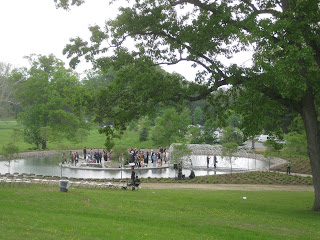
The site of the installation had changed greatly since I was last there in March. Having the "after, after the before gave me quick thrill. Defying the expectations set by the extravagance of some costly public art, the island is rather bland. This blandness also defies the expectations raised by much of this artist's other work and I think it should work well for the project as a whole going forward. This is no grand experiment in the tweaking of sensory perception. The work was created as a point of intellectual exchange, to facilitate social  gatherings and provoke debate.  It's an open air lecture hall, an academy in an approximation of the original sense: a venue where intellectual dialogue might be paired with the enhanced sensory input of exposure to the elements of nature.  This work is not apparently ostentatious (aside from creating a body of a water where there once was none in the middle of a grassy meadow). But this is sort of feature has been de riguer for upwardly mobile backyards for years, and in fact if this was in someone's back yard, there'd be the added feature a gazebo perched atop the island.  The swirling stainless steel canopy spanning the bridge is the only apparent glitz adorning the work.  This is a table, set simply, for the discurssive banquets to be held there. The work is also not complete. The plantings are new and will take several years of growth to ground the work to its site. Young trees belt the piece on the outer side of the moat. Standing on the disc. I tried to envision the effect that the fully mature trees would have on the space, anchoring it in place among broader environs.  Surely the plantings maturity will strengthen the geometry of the site and lend a sense of sheltered glade or nearly natural amphitheater. I imagine that in years to come this growth will provide the sensation of passing through an aperture as one passes over the bridge to the stone paved plaza of the island.  The island is paved in an arrangement such that the grout lines trace concentric geometric forms originating from a central cirucular stone with culminating in alignment of the cardinal points. The disc is ringed by seating in the form of large, irregular boulders.
CCS Director Tom Eccles kicking off the afternoon.

The afternoon session kicked off with a performance orchestrated by Andrea Zittel. The performance entailed four individuals tracing a square in, meeting one another at points along this square then turning back, all set to a pulsing soundtrack of a crushing, electric drone. There was something ceremonial, in an ancient way, in work. The repeated movements and the posture of the performers brought to mind lines of Irish step dancing - without that pasttime's more insidious traits.  I was anxious to see what Zittel had come up with as I have not seen to performance.  It was spartan and exhilarating.
Above and below:  moments from the performance by Andrea Zittel.

Following Zittel's piece, Molly Nesbit, professor of Art History at Vassar did a reading that spoke of the parliament and actions as a form of voting. She linked Eliasson's piece with a history of democratic gatherings in the region that predate Woodstock. I don't doubt the substantial content of her talk, but much of what she said gained little traction on the wagon trail track of my mind. At the end of her talk in an experiment of promoting an impromptu parliament, levelling the field amongst presentor and audience, she passed the microphone around to garner thoughts and responses from the entire group.
Professor Molly Nesbit giving her talk.

The microphone continued traveling through the gathered group before and after the final speaker, German philosopher, Pieter Slojterdijk. For me the most stirring words of the afternoon came from Sloterdijk, German Philosopher who spoke on the nature of reality by enumerating three human engineered projects that could well have huge impact on the perception of reality in the future.
 Pieter Slojterdijk
He enumerated three "clients" that could irrevocably alter humanity's tie to that which is considered "reality".
The first of his "clients" as he called them is Cern, which having recoved from damage incurred from defects in the facility's inaugural test last year is now ready to continue its exploratory work of observing the most elemental building blocks of the univers. The results of which could be (although infinitesimally small) creating a black hole and possibly bringing about the end of Physics as a discipline of experimental research. As the crowd giggled as Sloterdijk described the possible nature and progression of a man made black hole, I felt a bit of the ironic portense that is built up in a disaster movie as if we tempting fate in some 19th Century way. "OOhooh, men, flying in the air? preposterous!" Wonderfully creepy.
Sloterdijk's second client, is ETA, the ongoing attempt to create nuclear fusion of a sun-like intensity in a facility in the South of France. Paraphrasing Sloterdijk's imagining of the earth's epitaph: Born as a planet, it longed to be a star.
The final example cited was the International Space Station, the emblematic container of humanity's hopes for cosmologicol colonialism and our species' post-earth survival. How will our view of reality be shifted when life as we have known it, fully entangled in the fiberof its terrestrial host, is cast out into the void, expelled from our hospitable eartlhy womb?
Eliasson floated among the gathering, passing the mic, seeking to engender debate with the possibility of laying down the conversational ethos that would mark the tone of the place's future activities. Much of the talk leaned toward conjuring the practical out of the theoretical, making relevant the workings of this space.  The earnestness for affecting the world is always highly palpable at such events and virtually never actionable.

Olafur Eliasson on the mic.


Artist and writer Carol Diehl on the mic.

At one point, while I was standing on the edge of the island, I experienced a sensation that the disc was teetering slightly.  That of vertigo passed, but later as Eliasson was speaking about democratice structures and the idea of discourse and exchange, I realized the previous sensation was grasping at unconcious memory that offered an uncanny analogy to the structure of the piece and the idea of an arena for intellectual sparring:
How exciting!
The poles of high culture discourse and life or death contest are not as distant as the struggle between Flash and the Baron might suggest.  Sometime before the official opening of Parliament of Reality, a group of drunken students were apparently inspired to physical feats mischief, attempting to jettison one of the large boulders into the water, resulting in one student losing several fingers.
Though still nascent, the frogs have already claimed the space as their own. The moat of a pond is inhabited by tons of fat tadpoles. The conversations on the island was periodically accented with the oddly mechanized call of frogs resing on the bridge's canopy. The frogs' barking complimented the soundtrack of Zittel's work in such an uncanny way I, at first, believed it to be an additional sound piece.
Toward the end of the afternoon a man was complimenting Eliasson on his work and waxing rhapsodic about about how the artist's creations, the present one included, are breaking down walls, creating an egalitarian, democratic experience for all. I for one think that walls get a bum rap, and, for the record, I stand in praise of the good that a good wall can do....Robert Frost not withstanding.
In fact I sense that when the trees surrounding the feature mature, they will form a wall of sorts, buffering the island from the broader surroundings, enhancing the form and function of the piece.
It struck me as exceedingly funny and ironic that this man's praise of the demolishing of barriers was given while sitting on the only formation that is more exclusionary and divisive than a wall:  an island. 

Wednesday, May 20, 2009

Rick Price mural unveiling to be held May 23, 11-1pm

Rick Price at work on this latest mural.

Rick Price will be unveiling his most recent mural project this Saturday, May 23 from 11 to 1pm in the open space at the corner of Cross and Main St. The mural which is sponsored by the Beacon Sloop Club and which has received support from the Dutchess County Arts Council, the Puffin Foundation, the Woody Guthrie Foundation and Hudson Beach Glass along with other private individualswill be installed on the western face of the building housing RiverWinds Gallery at 172 Main St.

Sunday, March 22, 2009

Destination Art: Olafur Eliasson at Bard College

Olafur Eliasson, visualization of The Parliament of Reality, Bard College, Annandale-on-Hudson, New York.
© Studio Olafur Eliasson. via artdaily.org

Olafur Eliasson's first permanent installation in the United States is scheduled to open on the campus of Bard College on May 16, 2009. The work titled Parliament of Reality is located near the Richard B.
Fisher Center of Performing Arts Center. The $1.2 million project has been commissioned for Bard by the Center for Curatorial Studies at Bard and is funded by the Luma Foundation
From the Press Release issued by Bard College:
The Parliament of Reality consists of a circular pond approximately 135 feet in diameter surrounded by a ring of 24 planted trees. Nestled in the center of the pond is a circular island, paved with individual stones that inscribe a twelve-point pattern derived from the meridian lines of nautical charts and the compass. The island is accessed via a stone bridge covered by a steel latticework tunnel. Based on the island’s floor, the tunnel’s design is composed of a series of ellipses, which gradually intensify toward the point where the bridge and island meet. As visitors cross the bridge, the tunnel’s design appears to gradually shift, providing a symbolic temporal experience evocative of the work’s overall conceptual goals. Large, smooth boulders situated in two rows around the outer rim of the island provide seating.

Eliasson notes that the “Icelandic parliament is called the Althing, meaning: a space for all things.” He envisions this project as “a place where students, teachers, and visitors can gather to relax, discuss ideas, or have an argument.” Eliasson states that the project “emphasizes that negotiation should be at the core of any educational scheme. It is only by questioning what one is taught that real knowledge is produced and a critical attitude can be sustained.”


In early March I snapped a couple of photos of the installation site as work progressed. Above, you can see shimmering facade of the Gehry designed Fisher Center beyond the construction site.

Images from March 20, 2009. Van Brunt openings and Catherine Welshman at bau

Some of the crowd assembled at Hudson Beach Glass.

We made it out to two of Van Brunt's three opening sites last night. We also stopped into see Catherine Welshman's entertaining exhibit at bau.
The painter Stanford Kay (left) with friends in front of James Westwater's Hudson River landscape at Hudson Beach Glass.

above and below: views of Catherine Welshman's Girls Gone Wild at bau.


More folks at Van Brunt Gallery...and solid proof that Jennifer Mackiewicz has indeed migrated back to Beacon from Antarctica.

Above and below: Seeing may be Forgetting the Name of the Thing One Sees, but where would the world be if we didn't label everything? I understand there are a few other elements along Main St. that have been contextualized with the aid of some explanatory text. Consider it a scavenger hunt. This bench is located on the corner across from Hudson Beach Glass.

Wednesday, November 12, 2008

River Beacons mural viewing at Beacon Studios, Nov 15, 4-5:30pm


Rick Price at work on the "River Beacons" mural.
A pre-viewing of Rick Price's latest mural will be held on Saturday, Nov 15 from 4-5:30 at Beacon Studios. The yet to be completed mural is sponsored by the Beacon Sloop Club and is destined to be installed on the exterior wall of the building that houses RiverWinds Gallery as one of Beacon's official 2009 Quadricentennial projects. From the press release:

The River Beacons mural celebrates Beacon’s river town heritage and lifestyle, the Beacon Sloop Club’s replica sloop Woody Guthrie’s 30th anniversary, and the statewide Hudson-Fulton-Champlain Quadricentennial.
The painting, 15 feet high and 10 feet wide, will hang on the copious brick western wall of Riverwinds Gallery; on the corner of Cross Street and Main Street, facing Hudson Beach Glass. The location will make this mural highly visible to Beaconites and visitors, inviting both to enjoy, preserve and celebrate the Hudson River and Beacon’s river town heritage.
Support for the mural has been received from the Dutchess County Arts Council (DCAC), The Puffin Foundation, The Woody Guthrie Foundation, Michael Benzer - Hudson Beach Glass, and private supporters. Rick Price received the DCAC’s 2007 County Executive Award for Art in Public Places for his mural for Beacon’s Howland Memorial Library. The new mural is an official project of the Greater Beacon 2009 Quadricentenial Committee.
The mural is epic and colorful. Rick has chosen to frame this painting with the body of a female Esopus Indian figure, representing the bounteous energy that flows through the river community. The scenes and activities depicted on the Hudson’s waters and surrounding land record the river’s history – native American habitation, the passage of the Half Moon, the steamboat era – and reflect the diverse peoples, traditions, recreation and education that take place on our river front.
Recognizable elements in the mural of everyday river-related activity include the waterfront farmers’ market, environmental education at Beacon Sloop Club festivals, alternative energy use at DIA, kayaking, folk singing, the kids from the Beacon Community Center painting river life, theWoody Guthrie and theClearwater coasting along, the rainbow hued River Pool.

Friday, August 15, 2008

Eye Candy Friday: Temporeality

This weeks ECF selection is a snippet of vid I took last Saturday as Karen Brummund was installing her work at 469 Main St. as part of WOMS 2008.


The multi-staged, multi media piece incorporated adhering individual sheets of paper to the window, each carrying a portion of a window sized photo taken of the window by WOMS co-curator Matthew Slaats. The photo essentially depicts what the window saw via its reflection as Matthew was taking its picture: Matthew, standing in the street, camera to eye, some parked cars, and the Raindance boutique across the street. This treatment was repeated for the space's side window, and the window in the door.
The piece, from the start, was a temporary time based "performance" created by the window and the environment. (Karen refers to these works she creates as time-based drawings) (Please note that this is all my interpretation, as I hadn't discussed the piece at length with Karen.) A camera positioned in a parked car across the street on Saturday was automatically taking pictures of Karen installing the sheets of paper, and eventually, the wind taking them down, at which point a similarly scaled line drawn depiction of the original photograph went up in its place. The time elapsed video of this process will soon be available for viewing at Go North.

The line drawing portion of the piece.

I found this to be a particularly poetic piece, and I'm fortunate to have seen as much of is as I had on Saturday morning, as the piece was conceived to be fleeting. I was struck by the rhythmic waves moving through the mosaic of papers as the wind caught it, animating a frozen moment, depicted in photograph.

To stand in front of this piece in this window, was to stand in front of some trans-dimensional mirror, you see all the reflections you'd expect to see, except your own, which obviously would not be visible as you've been rendered a vampire. You do, however, see Matthew's ghostly voyeur aiming to snap your non-reflecting image for some nefarious purpose, like posting in a blog.

OK, I'm going too far, but this piece definitely spoke of the intermingling of past and present, the extension of a moment held indefinitely, then carried forth. The work also demonstrates the fullest extension of responding to place. Here, Karen frames her response through the eyes of another (Matthew), and through the experience of the place itself. It's a "If these walls could talk" sort of thing. Karen's is an oblique reference to history, and the brief retelling of a fading memory by an old girl on Main St.

The full piece as of Saturday evening, Aug 9

Unfortunately, the life span of the piece was curtailed due to objection by the property's owner. I'm not certain on what grounds he objected, but we certainly comply with the wishes of our hosts on matters such as this, and the piece was removed late in the evening of Aug 9. In any case, the piece was not destined to sit statically in the window through the run of the exhibit, this just expedited the dismantling and prevented viewers from experiencing the full arc of the piece, and that's a real loss.

As I said, a video depicting the rise and fall is expected to be at Go North Gallery for viewing, hopefully soon.
Much of Karen's work incorporates similar, and more ambitiously scaled architectural renderings place on the actual structures depicted. Here's a recent project described at usagnet.com and an interview with Karen on the Popcorn Youth blog

Wednesday, July 02, 2008

Public art on primetime

For your evening tv viewing pleasure, the Sunday Arts program on WNET will be airing an episode tonight at 8pm on public art in NYC and featuring Olafur Eliasson's Waterfalls that are on view now through the fall, Chris Burden's erector set at Rockefeller Center, and David Byrne's giant instrument. (thanks to MAN for the flickr links)
If you miss it tonight, the program will also be shown on July 6 at 1:30pm and July 12 at 2:00am